 DEX screener
 filters can leave no pairs matching your settings
· updated
DEX screener filters narrow the pair list, and an empty result can reflect conflicting conditions, restrictive thresholds, or a loading problem. Start by distinguishing a completed empty list from an unfinished request. Then check the selected market scope, measurement windows, and active bounds before changing anything. Relax one condition at a time while keeping the others fixed. A restored row helps identify the restriction, although its live figures still need to match the remaining settings.
An empty list and an unfinished load mean different things
A completed list with no matches and a screen that remains on a loading indicator call for different checks. The empty list concerns the selection criteria applied to the available data. A loading indicator leaves that comparison unresolved. An explicit error is another state: the request hasn't produced a usable answer. Record the visible state before adjusting thresholds, because changing filters during a failed load won't establish which condition excluded a pair.
Likewise, a populated list that lacks an expected pair presents a narrower problem than a completely empty screen. For a missing pair, check its measurements against the active conditions. For a completely empty screen, first establish whether loading has finished.
The field, unit, and bounds define each condition
Read each numeric condition as a measurement with a unit and an allowed range. Liquidity, trading volume, and valuation answer different questions, even when their displayed amounts use the same currency. A transaction count measures activity differently again. DEX Screener calculates fully diluted valuation by subtracting burned supply from total supply, then multiplying the remainder by price. Market capitalization can use a different supply basis, so a valuation comparison needs the correct field. For any minimum and maximum applied together, the minimum cannot exceed the maximum if a value is to satisfy both.
The selected chain and exchange restrict the starting list
A numeric filter only evaluates pairs within the market scope selected for the screen. A chain restriction excludes markets on other networks before their liquidity or activity becomes relevant. An exchange restriction narrows that scope further where the control is available. Keep the intended chain and exchange visible in your notes rather than recording only numeric thresholds. If a broader selection produces rows, that establishes that the broader selection has matches. It doesn't establish that the original market scope was incorrect or that it should be abandoned.
Can valid filters still produce no matches?
Yes, individually valid conditions can produce no matches when no available pair satisfies all the conditions applied together. A liquidity minimum may admit one set of pairs, while an age limit admits another. Their overlap can be empty even though neither setting contains an error. This differs from an impossible range, where the bounds themselves contradict each other. Loosening every condition at once obscures that distinction and makes it harder to identify which requirement matters.
Preserve the original settings before testing an adjustment. A changed result supports an explanation only when the remaining conditions stay comparable. Because market values move, a later result may also reflect changed data. Treat the appearance of rows as useful diagnostic evidence, then compare their relevant measurements with the conditions that remain active.
Match activity thresholds to their measurement windows
A volume or price-change threshold needs the same measurement window as the figure used to assess it. The discovery table displays price-change columns for five minutes, one hour, six hours, and twenty-four hours. Those columns describe different intervals. A pair's movement over a longer interval doesn't establish that it meets a condition for a shorter one. Read the period attached to the actual control instead of assuming that every visible time selector governs every measurement.
Chart intervals deserve separate attention during troubleshooting. Changing the grouping of chart candles doesn't establish that a list's activity filter changed too. Keep the list setting and the figure being compared explicit. For rolling activity measurements, the covered period advances with time, so the same saved threshold can admit different pairs later.
Liquidity and trading activity can exclude different pairs
Liquidity describes assets available in a pool, while volume describes trading activity over a period. Neither measurement supplies the other. A pool can have liquidity while experiencing little recent trading, and substantial trading volume doesn't establish that its liquidity exceeds your chosen floor. Transaction counts add another distinct condition because trade sizes vary. When several activity requirements are active, identify which measurement falls outside its range. Reducing a liquidity floor solely to populate the screen changes the markets admitted; it doesn't repair a volume mismatch or establish that those markets suit the original task.
Why did the results disappear without a settings change?
Results can disappear without a settings change because live measurements and time-based conditions can move beyond the bounds that you saved. The filter rule may remain identical while the values evaluated against it change. Liquidity and price-derived valuations can move, and activity within a rolling window can rise or fall. Pair age also advances, so a maximum-age condition eventually excludes pairs that previously qualified. This is expected behavior when the condition itself remains satisfied only temporarily.
A reproducible selection therefore means preserving the rule, rather than expecting permanent membership in the list. Note when the discrepancy occurred and which measurement appeared close to its boundary. If the relevant values no longer satisfy the saved criteria, the empty result has a different explanation from a failure to apply those criteria.
Missing measurements leave some comparisons unresolved
A missing value cannot establish that a pair satisfies a numeric threshold. The pair-data schema permits null values for liquidity, fully diluted valuation, and market capitalization. This matters when investigating an expected match: a blank valuation doesn't prove that the value sits below your maximum. It also doesn't prove that the value is zero. Keep the unavailable measurement separate from the numeric bounds you intended to apply.
The screen's treatment of unavailable values needs to be observed rather than inferred from the existence of a filter. Exclusion could relate to missing data, another active condition, or a different pair record. An address lookup can help identify the intended pool, but finding its chart doesn't establish that the pool satisfies the list's filters.
If the measurement remains unavailable, leave that comparison unresolved. Substituting another field would change the condition being tested.
Will changing the sort order restore excluded pairs?
Changing only the sort order rearranges eligible results; it doesn't make a pair satisfy a failed filter condition. Sorting can explain why an expected row isn't near the top of a populated list. It cannot resolve contradictory bounds. A switch to another discovery view deserves separate treatment because it may change the population being displayed, rather than merely rearranging the same rows. Compare the active view and conditions before treating a newly visible pair as evidence that sorting fixed an empty list.
Browser checks belong after the filter state is recorded
If the screen won't finish loading or retain the intended settings, record the visible conditions before investigating the browser. A reload, fresh tab, or separate browser session can help distinguish a display problem from a repeatable selection result. These checks only support a comparison when the active view and filter values match. An unfiltered screen loading elsewhere doesn't establish that the original combination should return rows.
Browser extensions deserve attention when they alter the page or apply additional screening. If such an extension is installed, its settings form another possible source of exclusions. A temporary test without its page modifications can isolate that dependency without deleting the original configuration. Avoid changing multiple extensions and several filter values together, because that removes the ability to connect an observed change to a specific adjustment.
For a reproducible failure, useful evidence includes the active settings, approximate observation time, visible error, and public pair identifier when relevant. Remove unrelated account information from screenshots. Private keys, recovery phrases, and transaction signatures aren't needed to explain why a public screening list is empty.
Verify the smallest change before keeping it
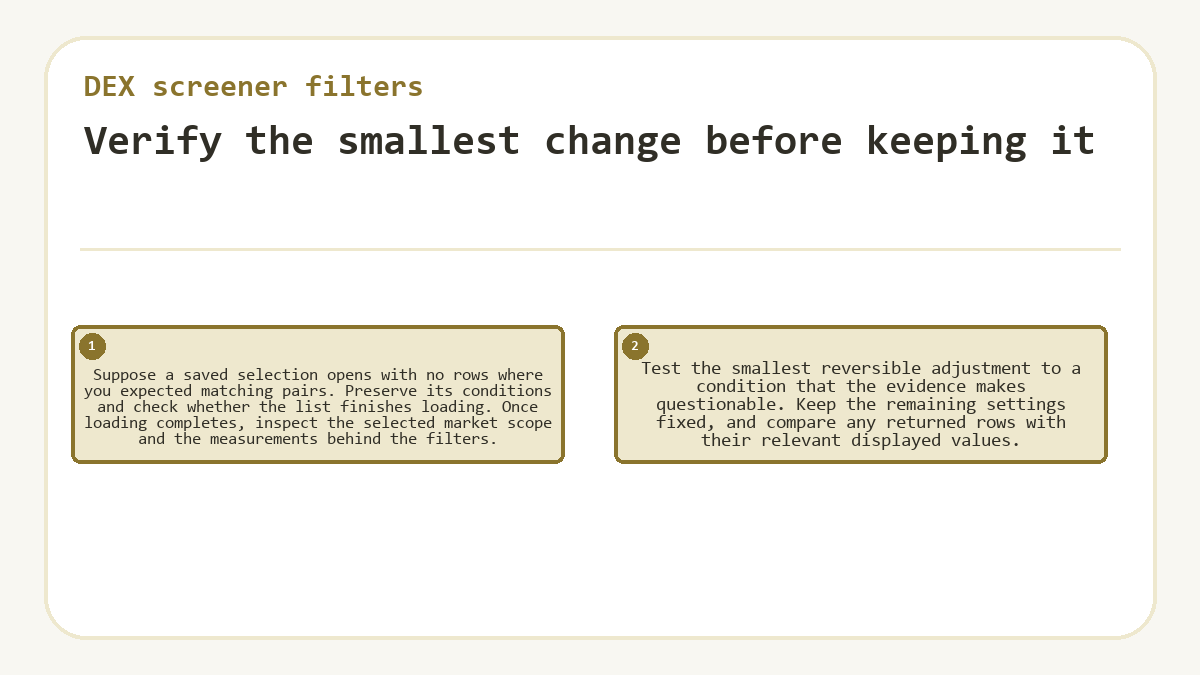
Suppose a saved selection opens with no rows where you expected matching pairs. Preserve its conditions and check whether the list finishes loading. Once loading completes, inspect the selected market scope and the measurements behind the filters. Test the smallest reversible adjustment to a condition that the evidence makes questionable. Keep the remaining settings fixed, and compare any returned rows with their relevant displayed values.
- If loading continues or an error appears, investigate that state before interpreting the absence of matches.
- If the selected chain or exchange differs from the intended market, correct that selection before changing numeric bounds.
- If a minimum exceeds its corresponding maximum, correct the contradictory range and retain the other conditions.
- If the ranges are coherent, relax one suspect condition and inspect whether the returned rows explain its effect.
- If the intended criteria correctly exclude every available pair, keep the empty result; if the same loading failure repeats, preserve the evidence for support.
A populated list confirms recovery only when it reflects the intended scope and the settings you chose to keep. If restoring a meaningful restriction removes all rows again, the restriction may be working correctly. Waiting is useful when the relevant market data or loading state can change; repeating the same request won't resolve contradictory bounds. End the test with either a supported explanation for the empty list or a clearly reproducible unresolved failure.
Good to know
-
Does an old bookmark guarantee that my original filter settings are active?
- An old bookmark doesn't establish which settings are active after the page opens. Compare the visible market selection, numeric bounds, and measurement periods with your saved notes. Treat the displayed configuration as the basis for troubleshooting. A familiar page title or similar-looking table isn't enough to confirm that the intended conditions were restored.
-
Should I enter zero to remove a numeric filter?
- Zero and an unset condition aren't necessarily equivalent. Zero is a numeric input, while clearing a condition removes its restriction when the interface supports that action. Use the control's clearing behavior and inspect the resulting setting. Don't assume that entering zero disables every minimum or maximum field.
-
How should I check a filter value pasted from a spreadsheet?
- Check the value that remains in the field after entry, including its sign, decimal placement, and unit. Copied text may contain formatting that a numeric control doesn't accept or interprets differently. Avoid assuming that currency symbols, grouping separators, or abbreviated amounts were converted correctly. Compare the accepted value with the original intended quantity.
-
Are negative price-change bounds reversed when filtering losses?
- Negative price-change bounds retain their ordinary numeric order. A more negative value is lower than a value closer to zero. Read minimum and maximum as lower and upper numeric bounds, rather than smaller and larger loss descriptions. Confusing those meanings can create a contradictory range even when both entries are valid percentages.
-
When is copying someone else's filter preset useful for troubleshooting?
- A copied preset is useful only when its individual conditions can be compared with your intended selection. Different market scopes, time windows, and numeric bounds answer different screening questions. A preset returning rows doesn't show that your original settings were broken. It establishes only that another combination currently has matches.
-
Is clearing browser storage the first fix for an empty filtered list?
- Clearing browser storage is a poor first diagnostic step because it can remove saved preferences and obscure the original configuration. Record the settings before considering a reset. A completed list with coherent conditions may correctly contain no matches, so deleting local data wouldn't address its cause. Reserve broader resets for evidence of a browser-state problem.